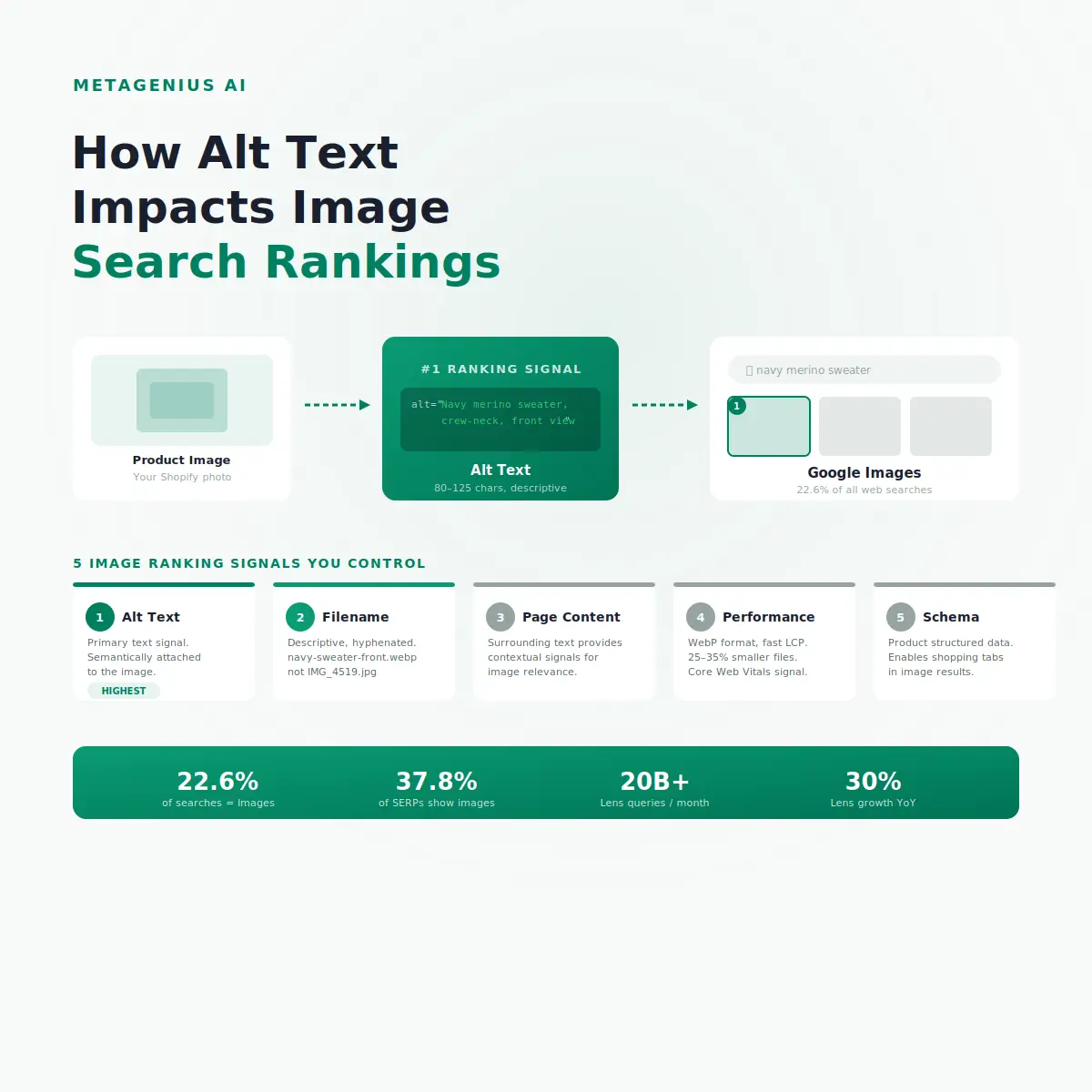
Most Shopify merchants think of alt text as an accessibility checkbox — something you fill in because a plugin told you to. That undersells it dramatically. Alt text is the primary signal Google uses to understand, index, and rank your images in Google Images. And Google Images isn't a side channel anymore — it accounts for 22.6% of all web search traffic and appears on 37.8% of search result pages.
For e-commerce stores, that's a high-intent traffic stream where shoppers search for exactly what your products look like: "navy slim-fit blazer," "ceramic pour-over set," "gold hoop earrings." Every product image without descriptive alt text is invisible in that channel.
This post breaks down exactly how alt text impacts image search rankings — the mechanism, the distinction from web search, the five signals you control, and the practical steps to turn your product images into a ranking asset.
How Google Ranks Images (The Short Version)
Google Images uses a ranking system that's related to but distinct from regular web search. It considers a combination of signals to decide which images to show for a given query:
- Text signals: Alt text, image filename, caption text, surrounding page content, title tags. These tell Google what the image is about in human-readable terms.
- Visual signals: Google's computer vision algorithms (including the technology behind Google Lens) analyze the actual visual content of the image — shapes, colors, objects, text within the image.
- Page quality signals: The overall E-E-A-T of the host page, Core Web Vitals (especially Largest Contentful Paint for hero images), mobile-friendliness, and structured data.
- Freshness and authority: Recently updated images on authoritative domains rank higher for trending or time-sensitive queries.
Of these, the text signals are the ones you have the most direct control over. And within text signals, alt text carries the most weight — it's the only text that is semantically attached to the image itself, rather than being inferred from proximity.
Alt Text's Role in Image Search Rankings
John Mueller has been explicit about this: alt text is "extremely helpful" for ranking in Google Images. It's Google's primary text signal for understanding what an image depicts and matching it to search queries. For the full data on how alt text affects where your images rank in Google Images, see how alt text impacts image search rankings.
Here's why alt text specifically matters more than other text signals for image rankings: Alt text is the #1 ranking signal for Google Images, which drives 22.6% of all search traffic — our alt text image search rankings guide breaks down the data.
- Semantic attachment. Alt text is inside the
<img>tag'saltattribute — it's structurally linked to the image in a way surrounding paragraph text isn't. Google treats this as a direct description, not an inference. - Query matching. When a user searches Google Images for "ceramic pour-over dripper in matte terracotta," Google matches that query against alt text strings across its index. A product image with
alt="Ceramic pour-over dripper in matte terracotta, top-down view"is a near-exact match. - Disambiguation. A page might have 8 images of the same product in different colors. Alt text is the only signal that tells Google which image is the terracotta variant and which is the slate grey one.
Mueller also cautioned against relying on Google's computer vision as a substitute for alt text. In a Reddit discussion, he noted that while AI can recognize objects in an image, it can't provide the context for how that image relates to the page content. A photo of a beach could be about a hotel location, a cleanup project, or a surfboard product — only alt text (and page context) disambiguates.
Image Search vs Web Search: Different Games, Different Rules
This is the counterintuitive insight that most SEO guides get wrong: alt text is an image search ranking factor, not a web search ranking factor. Good alt text does more than accessibility — it's the primary signal for image search rankings, which account for 22.6% of all web search traffic.
Mueller clarified this in a 2022 Google Search Central Office Hours hangout. Google doesn't see a page as more valuable in web search because its images have alt text. Adding alt text to your product images won't directly move your product page up in regular Google results for "buy navy blazer."
What it does is open a separate traffic channel. When someone searches Google Images for "navy slim-fit blazer," your product image can appear — and that click goes directly to your product page. For e-commerce, this image traffic is often higher-intent than organic web traffic because the shopper has already seen the product visually and is clicking through to buy.
There's a nuance worth noting: Google has confirmed that alt text is treated as regular on-page text for web search purposes. It contributes to the page's overall text content the same way a paragraph would. But it doesn't carry special weight — it's just more words on the page. The special ranking power of alt text is reserved for image search.
The 5 Image Ranking Signals You Control
Alt text is signal #1, but it works best alongside four other signals that you can optimize directly. Here's the full stack, ranked by impact:
1. Alt text (highest impact)
Descriptive, keyword-natural, 80–125 characters. Follow the formula: [Product name] + [variant detail] + [visual context]. For the full deep-dive on length, see our alt text character limit guide.
2. Image filename
Rename IMG_4519.jpg to navy-merino-crew-neck-sweater-front.webp before uploading. Google extracts keywords from filenames and uses them as a secondary text signal. Hyphens between words, lowercase, descriptive. Note: Shopify preserves the filename you upload — it doesn't rename files automatically.
3. Surrounding page content
Google reads the text near an image to understand context. A product image embedded in a page that's rich with relevant product details, specs, and reviews gives Google stronger signals than an image on a thin, template-only page. This is where product descriptions and Shopify product SEO intersect with image rankings.
4. Image file format and performance
WebP delivers 25–35% smaller files than JPEG with no visible quality loss. Smaller images load faster, which improves your Largest Contentful Paint (LCP) score — a confirmed Google ranking factor. Since the March 2025 Core Update, Google has further weighted page performance signals, and hero images are almost always the LCP element on product pages.
5. Structured data (Product schema)
Product schema markup with the image property helps Google connect your product images to shopping results, Lens matches, and rich snippets. This signal matters most for e-commerce because it enables direct shopping integrations in Google Images — the "Shop" tab that appears below product image results.
The E-commerce Opportunity Most Stores Miss
A 500-product Shopify store with 4 images per product has 2,000 images in Google's index (or should). Each image is a potential entry point from Google Images. If even 10% of those images rank for relevant product queries, that's 200 additional pathways for shoppers to find your store — without writing a single blog post, without spending a dollar on ads.
The math gets compelling fast. If those 200 ranking images each drive 5 clicks per month at a 2% conversion rate with a $75 average order value, that's:
- 200 images × 5 clicks = 1,000 visits/month from image search
- 1,000 × 2% conversion = 20 orders/month
- 20 × $75 AOV = $1,500/month in additional revenue
That's from a channel most stores completely ignore. And the cost of entry is alt text — something MetaGenius AI handles for $4.99–$14.99/month across your entire catalog.
Stores in visually-driven categories — fashion, jewelry, home goods, beauty, food — see even stronger returns because shoppers in these niches use Google Images as a primary discovery channel. A shopper searching "gold hoop earrings" in Google Images is further down the purchase funnel than someone typing the same query in regular search.
Google Lens, Visual Search & Alt Text
Google Lens processes over 20 billion visual searches per month — and that number is growing at roughly 30% year over year. For e-commerce, Lens is a product discovery engine: a user points their camera at a pair of shoes, and Google surfaces visually similar products from its index.
Lens primarily uses visual matching (computer vision), not text signals. But alt text and Product schema provide the contextual layer that determines which visually similar products Google surfaces and in what order. A product image with descriptive alt text and proper structured data beats an identical-looking image with alt="" because Google has more confidence in what that product actually is.
The practical implication: optimizing alt text for Google Images and optimizing for Google Lens aren't separate strategies. The same descriptive, product-specific alt text serves both channels. Clean product photography (studio shots on white backgrounds) helps Lens matching, and descriptive alt text helps Lens ranking.
How to Optimize Alt Text for Image Search Rankings
Applying this to your Shopify store is straightforward. Here's the action list:
- Audit your current alt text. Open Google Search Console → Performance → Search type: Image. Check which images rank, which have impressions but low position (those are your optimization candidates).
- Apply the formula. For every product image:
[Product name] + [variant detail] + [visual context]. Stay in the 80–125 character sweet spot. - Differentiate every image. Multiple images of the same product need unique alt text — front view vs back view, styled vs flat lay, color A vs color B. See our 30+ real alt text examples for category-specific templates.
- Fix your filenames. Rename before uploading to Shopify.
navy-merino-sweater-front.webp, notIMG_4519.jpg. - Add Product schema. Include the
imageproperty pointing to your main product images. This enables shopping integrations in image results. - Monitor in Search Console. Check Image search performance monthly. High impressions + low position = alt text improvement opportunity.
For bulk execution across hundreds of products, see our guide to bulk adding alt text in Shopify. For single-image methods, see how to add alt text in Shopify.
Turn 2,000 product images into 2,000 ranking opportunities.
MetaGenius AI generates ranking-optimized alt text for every product image in your Shopify catalog — descriptive, unique, within the optimal character range. Free plan includes 10 generations.
Install Free on Shopify →Frequently Asked Questions
Your product images are a ranking asset. Treat them like one.
MetaGenius AI generates ranking-optimized alt text for every product image in your Shopify catalog — in bulk, in seconds, in 15 languages. Install the app. Select your products. Click "Generate." Review and publish.
Install Free on the Shopify App Store →