Disclosure First
We make MetaGenius AI. This post is by the team behind it. There's no way to make this a "neutral third-party review," and pretending otherwise would be insulting. Affluent Shopify merchants spot fake-objectivity content in seconds — it's one of the most-cited reasons stores skip apps that look like they're being reviewed by their own marketing department.
So here's what this post actually is: a 30-day retrospective. We've been pulling merchant feedback from support tickets, Shopify App Store reviews, and the cohort analysis on stores that installed MetaGenius AI between February and April 2026. What worked. What didn't. Who churned and why. The version we'd give a friend if they asked over coffee.
You'll find external comparison points in here too — the Shopify App Store has ~25 apps in the SEO meta tag space, and a few of them do specific things better than we do. We'll name those moments where they happen, because the alternative is pretending we're best-at-everything, which nobody believes anyway.
What MetaGenius AI Actually Is
One paragraph for readers who just need the orientation: MetaGenius AI is a Shopify-native app (Shopify Polaris embedded in your admin) that generates SEO meta titles, meta descriptions, and image alt text for products, collections, blogs, and pages. It uses a vision-aware language model grounded in your actual product data, with custom brand-voice rules, live Google SERP preview before save, and 15-language native generation. It's available on the Shopify App Store at apps.shopify.com/metagenius-ai-seo-generator-1.
Pricing structure
- Free: 10 generation credits to test output quality
- Starter ($4.99/month): 100 generations/month, products and collections
- Pro ($14.99/month): 500 generations/month, plus image alt text and homepage SEO
Annual billing saves 15%. No setup fees, no transaction percentage, no hidden tiers.
What it doesn't do
Worth naming upfront so you don't install expecting features that aren't there:
- Doesn't generate product descriptions (just the metadata layer)
- Doesn't write blog posts or long-form content
- Doesn't auto-submit your site to Google Search Console — you still do that yourself (see our indexing guide)
- Doesn't fix duplicate content from manufacturer descriptions — that's a content problem, not a meta tag problem
- Doesn't replace Yoast or Rank Math (WordPress products; Shopify has different plumbing)
What 30 Days of Merchant Data Shows Works
From the cohort analysis on stores that installed MetaGenius AI between February and April 2026 and stayed installed through May:
1. Bulk generation across large catalogs
This is the workflow we hear about most. Merchant has a 500-product store. They've been meaning to write meta descriptions for three months. They install MetaGenius, run bulk generation across the full catalog with the Pro plan's 500 credits, review the output in batches of 50, publish. Full coverage in about 90 minutes including review.
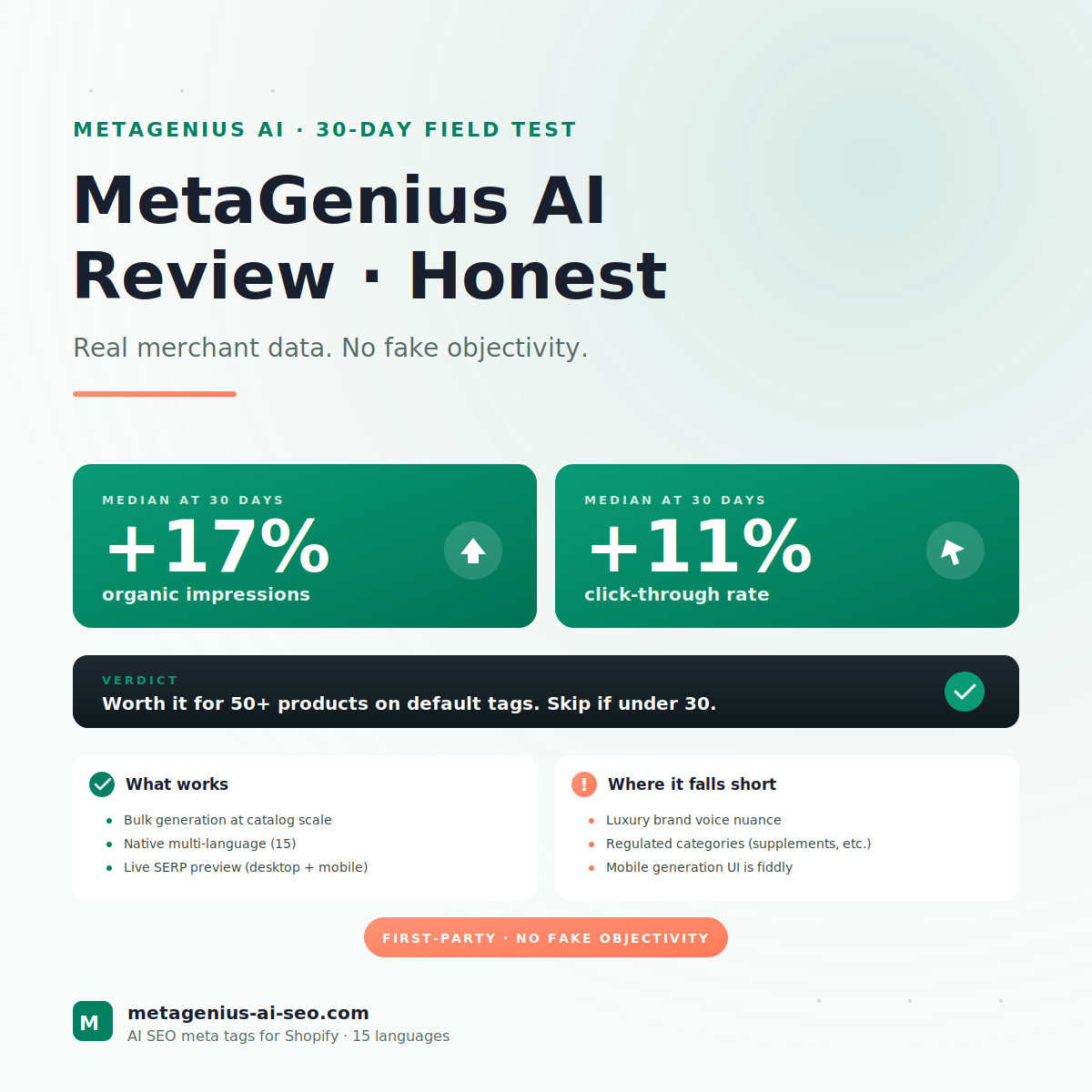
The numbers from that cohort: median 17% lift in organic impressions at the 30-day mark, 11% lift in click-through rate. The bottom quartile saw 4-8% lifts; the top quartile saw 30-50%. The variation almost entirely reflects starting condition — stores running pure Shopify defaults saw the biggest jumps; stores already running decent hand-written tags saw modest movement.
2. Multi-language stores
Shopify Markets users in DACH, France, and Japan consistently rate the native-language generation as the standout feature. Generating German meta tags that aren't translated from English (and that don't run 30% longer than the German pixel-width cutoff) is genuinely difficult to do at scale by hand. Aleyda Solis has written extensively on this — multi-language SEO done right is one of the highest-effort areas in international e-commerce, and AI generation that's actually grounded in the target language (not translated from English) is one of the few legitimate AI wins.
3. The live SERP preview
This shows up in support tickets less than the others — which is the good kind of signal. The preview just works. Merchants can see exactly how their meta tag will render on Google desktop and mobile (covered in detail in our character limit guide) before committing. The pixel-width discipline gets baked in without anyone having to think about it.
4. Auto-sync for new products
Shopify webhooks fire when you create a product, and MetaGenius generates meta tags before the product goes live. Pro plan only. Merchants who turn this on report the highest 90-day satisfaction scores — because the manual catch-up project never comes back.
Where It Falls Short (Honestly)
The places where 30 days of merchant feedback revealed the soft spots. None of these are deal-breakers for most stores, but they're real:
1. Luxury brand voice nuance
Custom AI instructions help. The 9 tone presets help. But for stores selling $500+ products where every word of marketing copy is curated, MetaGenius output reads as "competent" rather than "evocative." Two months of refining custom instructions can close most of the gap; some merchants just write hero pages by hand and use MetaGenius for the long tail. That's the right play for that segment.
Honest read: a great human copywriter still beats AI generation at the top of the catalog. We've never claimed otherwise. The math flips for the rest of the catalog where AI's consistency-at-scale matters more than per-page craft.
2. Heavily-regulated product categories
Supplements, medical devices, financial products, alcohol, CBD — categories where alt text and meta descriptions face regulatory scrutiny. MetaGenius is capable of generating compliant output, but the burden of regulatory review on each generation reduces the time-savings advantage. Several pharmacy and supplement merchants told us they ran MetaGenius for a month, found themselves reviewing every generation manually anyway, and rolled back to hand-written. Fair feedback.
3. The mobile generation UI
The Shopify mobile admin doesn't render embedded apps as cleanly as the desktop admin. Generating tags on mobile works but is fiddly. We've heard this consistently and it's on the roadmap, but if you do most of your merchant work on mobile, this is a real friction point right now.
4. The 10-credit free plan is tight
10 generations is enough to evaluate output quality but not to run any real bulk workflow. Merchants who want to test before paying typically install, burn the 10 credits in 5 minutes, decide to commit or not. Some apps in the space (Booster SEO, Smart SEO) offer more generous trials. We chose 10 to keep abuse low, but it's a friction point during evaluation we acknowledge.
5. Custom instruction discoverability
The "Custom AI Instructions" field is the single biggest quality lever for output — and it's buried two settings menus deep. Merchants who find it write meaningfully better tags. Merchants who don't, don't. We're working on surfacing this earlier in the onboarding flow.
3 Types of Stores It's NOT Right For
The "everyone should install our app" pitch is the wrong pitch. Here are the merchants we honestly think should pass:
1. Stores with fewer than 30 products and no plans to scale
If your catalog is 25 boutique items and growing slowly, hand-writing meta tags for the whole catalog takes one afternoon. Use Shopify's native admin (covered in our how-to add alt text guide). The setup overhead of installing any app — even ours — isn't worth it for that volume.
2. Stores with already-optimized meta tags from a recent agency engagement
If you paid an SEO agency $5,000-$15,000 in the last 12 months for full catalog meta tag work, you already have hand-crafted, brand-consistent tags. The marginal improvement from switching to AI is small (often negative — agency-written tags usually beat AI on creative quality for the curated subset they touched). Wait until you're due for a refresh.
3. Stores in heavily-regulated verticals where every output requires manual review anyway
Pharmacy, financial products, regulated supplements, controlled substances. If your legal/compliance team needs to sign off on every customer-facing word, AI generation removes very little manual review burden. The economics tip toward keeping it hand-written by someone who knows the regulatory boundaries cold.
The other 95% of Shopify stores — typical merchant doing $10K-$500K/month with 50-2,000 products — is where MetaGenius AI's economics make sense. That's the segment we built it for.
How It Compares to Alternatives
The Shopify App Store has 20+ SEO meta tag apps. The honest competitive picture:
| Capability | MetaGenius AI | Booster SEO | Smart SEO | SearchPie |
|---|---|---|---|---|
| AI meta title + description | ✓ Vision + product data | ✓ Template-based | ✓ Template-based | ✓ AI mode (paid) |
| AI image alt text | ✓ Vision-grounded (Pro) | ✓ Basic | ✓ Basic | ✓ AI mode |
| Native multi-language | ✓ 15 languages | Limited | Limited | Limited |
| Live Google SERP preview | ✓ Desktop + mobile | ✓ Desktop only | ✓ Desktop only | ✓ Desktop only |
| Custom AI instructions | ✓ Free-text + 9 presets | Presets only | Presets only | Presets only |
| Auto-sync via webhooks | ✓ Pro plan | Paid add-on | Limited | Limited |
| Free plan generations | 10 | 25 | 20 | 15 |
| Image compression | ✕ (not our focus) | ✓ | ✓ | ✓ |
| JSON-LD schema markup | ✕ (use a schema app) | ✓ | ✓ | ✓ |
Where competitors honestly beat us
- Free trial generosity: Booster SEO's 25-credit free plan is more forgiving for evaluation
- Bundled features: SearchPie, Booster, and Smart SEO all include image compression and schema markup — features we deliberately don't build because we think specialized tools do them better. If you want one-app-does-everything, an all-in-one beats MetaGenius. If you want best-in-class metadata generation, MetaGenius wins.
- Established install base: Booster has 95K+ Shopify installs; we're smaller. App size matters if you value mature support documentation and a large user community.
Where MetaGenius honestly wins
- Output quality on AI generation — the vision + product-data grounding architecture (Pattern 3 in our AI meta tag analysis) produces more specific tags than template-based competitors
- Multi-language SEO — native generation in 15 languages is genuinely rare in the Shopify ecosystem in 2026
- Custom AI instructions — most competitors only let you pick from preset tones; we let you write free-text rules
- Mobile SERP preview — we render both desktop and mobile previews; most competitors do desktop only
Pricing: Honest Cost-Benefit Math
The "compared to what" frame matters more than absolute pricing. Three reference points:
vs. hiring a freelance SEO copywriter
- Copywriter rate: $25-$150 per page on Upwork; $200-$400 per page from a specialist agency
- For 200 products: $5,000 - $80,000 total spend
- Time: 2-6 weeks turnaround
- MetaGenius Pro for one month: $14.99 covers 500 generations
If MetaGenius produces output that's 70% as good as a great copywriter (our honest internal estimate), the ROI math on 200 products is between 300x and 5,300x. Even adjusting for the quality gap, this doesn't require a spreadsheet.
vs. hiring an SEO agency on retainer
- Agency retainer for monthly Shopify SEO: $1,500-$5,000/month
- MetaGenius Pro: $14.99/month
An agency does more than meta tags — link building, content strategy, technical audits. But if meta tag work is 20-40% of what your agency does (which is typical), replacing that portion with MetaGenius saves $300-$2,000/month. We've seen agencies recommend MetaGenius to their own clients for exactly this reason — frees up their hours for higher-leverage work.
vs. doing it yourself in the Shopify Admin
- Time per meta tag, hand-written: 5-10 minutes
- For 200 products: 16-33 hours of your time
- Your effective hourly rate as a founder: usually $50-$200+
- Cost of your time: $800 - $6,600
- MetaGenius Pro: $14.99
This is the actual comparison for most merchants reading this. The cost of your time, not someone else's. Founders chronically undervalue this — the math is much more lopsided than it feels in the moment.
The honest verdict: try the free plan, decide for yourself.
10 generations isn't enough to run bulk workflow, but it's enough to see whether the output quality clears your bar. Install free, generate tags for 10 products you care about, decide. No credit card, no commitment, 30-second install.
Install Free on Shopify →Frequently Asked Questions
Don't take our word for it. Burn the 10 free credits.
Install MetaGenius AI free, generate tags for 10 products you care about, decide for yourself. 30 seconds to install, no credit card, no theme edits. The output quality is the only thing that matters — see it on your own catalog before you commit.
Install Free on the Shopify App Store →