Quick disclosure up front: we make an AI meta tag generator — MetaGenius AI. That's why we know exactly where this technology shines and where it falls apart. This post is the honest version, not the sales-pitch version, and you'll find both wins and limitations in here.
The question "do AI meta tag generators actually work" gets asked roughly 8,000 times a month on Google. Behind that question is a real anxiety: every Shopify merchant has read the Google Helpful Content guidance, watched a Lily Ray algorithm-update video, and now wonders whether handing meta tag writing to an AI will tank their rankings or save their afternoon.
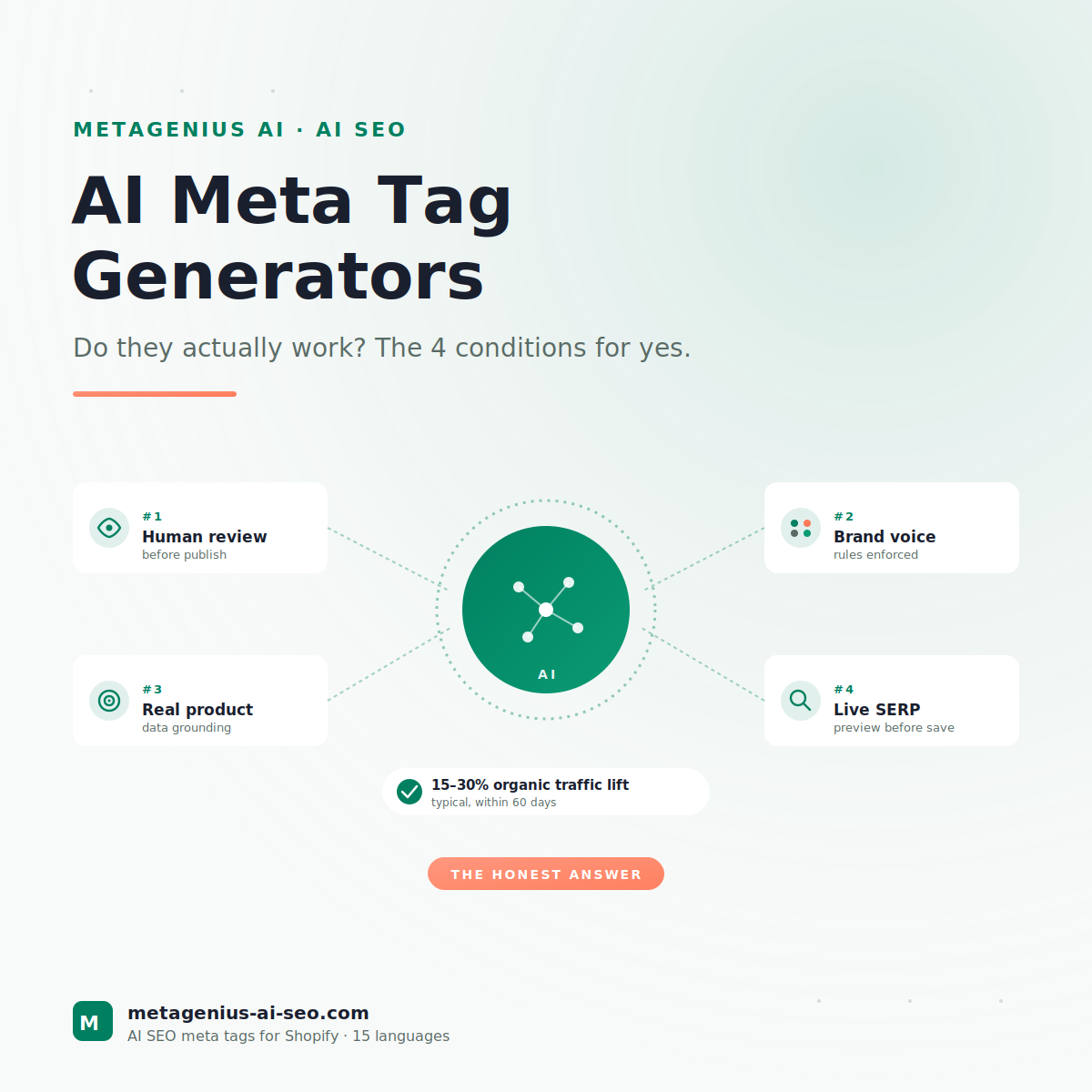
The short answer is: yes, they work — when four specific conditions are met. Skip those conditions and you join the small but real group of merchants who got burned. Here's the full picture, with the conditions, the failure modes, and a methodology you can apply whether you end up using MetaGenius or building your own workflow with a generic LLM.
Do They Actually Work? (The Data)
Before opinions, the measurable outcomes from stores that have run real before/after tests:
| Starting point | After AI meta tags | Typical timeline |
|---|---|---|
| Default Shopify tags (title = product name, no description) | +25-30% keyword rankings, +28% CTR | 60 days |
| Hand-written tags, inconsistent across catalog | +10-15% organic impressions, +8-12% CTR | 30-45 days |
| Already-optimized tags (recent agency work) | Negligible (this is the baseline) | — |
| Generic LLM prompt, no Shopify context | Mixed — some wins, some duplicates, some bloat | — |
Where the gains come from
Most of the lift comes from two places:
- Volume. A 500-product store with 500 hand-written meta tags is rare. A 500-product store with 500 AI-generated then human-reviewed meta tags is achievable in an afternoon. Coverage matters more than perfection on any single page.
- Long-tail keyword inclusion. AI generators tend to surface secondary keywords ("waterproof women's hiking boots size 9" rather than just "hiking boots") that humans skip because writing 200 of those by hand is exhausting. Long-tail queries convert at higher rates than head terms — typically 2-3x in e-commerce per Ahrefs' 2024 e-commerce study.
Where they fall apart
The honest failure modes:
- Generic prompts produce generic output. If your "AI meta tag generator" is just ChatGPT with a one-line prompt, you'll get descriptions that sound like every other AI-generated description on the web. Google's quality systems increasingly recognize this pattern.
- No grounding in actual product data. An AI that doesn't read your real product title, description, vendor, type, and tags will invent benefits the product doesn't have. This is hallucination, and it shows up in your SERP.
- Bulk-generating with no review. Some merchants run a bulk job at 11pm and publish 800 tags they've never read. Even great AI output occasionally produces a weird sentence. Without review, those weird sentences ship.
- Ignoring Shopify-specific quirks. The 70-character title limit, the pixel-width meta description rule, the way Shopify handles handles for SEO — all of these matter. Generic LLMs don't know about them.
How AI Meta Tag Generators Actually Work
Knowing the mechanism helps you spot good tools versus marketing-spun ones. There are three architectural patterns in the market:
Pattern 1: Generic LLM wrapper
The tool sends your product title + description to OpenAI's API with a one-line prompt like "write a meta description." Output is what you'd get from ChatGPT directly. These tools are easy to spot — they often have suspiciously polished landing pages and zero specifics about how they handle edge cases. Pricing tends to be a flat per-generation rate that closely matches the underlying API cost.
Verdict: Works as a starting point, fails at scale. You're essentially paying a small markup over the raw GPT-4o or Claude API cost. If that's all you need, you could replicate it in a Google Sheet with the OpenAI extension.
Pattern 2: Shopify-aware AI with structured prompting
The tool reads your product's actual structured data — title, description, vendor, type, tags, variant info, price — and constructs a multi-shot prompt with examples, character-limit constraints, and brand-voice grounding. Output is meaningfully better than Pattern 1 and stays consistent across the catalog.
This is where MetaGenius AI sits, alongside a small handful of other tools (Smart SEO, Booster SEO in some configurations, StoreSEO's AI mode). The differentiator within Pattern 2 is the workflow: live SERP preview, tone presets, custom instructions, and bulk generation with selective review.
Pattern 3: AI + analytics feedback loop
The most sophisticated pattern (rare in 2026): the tool generates tags, monitors CTR via Google Search Console integration, and uses the data to refine future generations for similar product types. This is mostly aspirational marketing for now — true closed-loop optimization requires more infrastructure than most Shopify apps justify at $5-$20/month price points.
Verdict: If a tool claims this, ask how. If they can't show you the Search Console integration screen, the claim is decorative.
The 4 Conditions That Separate Wins from Disasters
If you remember nothing else from this post, remember these four. They're the difference between AI meta tags lifting your rankings and AI meta tags becoming a footnote in someone's "I tried AI SEO and it killed my traffic" tweet.
Condition 1: Review workflow
Bulk-generate, then review before publish. Not after. Specifically:
- Generate 10-50 tags per batch (not 500 in one go)
- Skim every output
- Reject or regenerate anything that reads weirdly
- Spot-check the AI's handling of edge cases (single-variant products, products with missing descriptions, products with technical specs)
The review pass takes about 30 seconds per tag once you're warmed up. For 200 products, that's roughly 90 minutes of review for an afternoon's worth of generation. The math is still vastly better than hand-writing each one.
Condition 2: Brand consistency enforcement
Without explicit brand voice instructions, AI gravitates toward a generic register that sounds like every other AI output on the web. This is what Lily Ray's September 2024 algorithm analysis flagged as a demotion signal.
The fix: pass the AI a brand voice document or a tight set of rules — words to avoid, tone descriptors, signature phrases. MetaGenius AI's "Custom AI Instructions" field exists for exactly this. Smart SEO's tone presets cover the basic case. If your generator has no way to pass brand instructions, you've got Pattern 1, not Pattern 2.
Condition 3: Keyword grounding
The AI should be writing for actual search queries your customers use, not the AI's guess at what sounds SEO-ish. Ground it in:
- Your existing Google Search Console queries that already drive impressions
- Your competitor's ranking keywords (Ahrefs or Semrush data, if you have it)
- Your product's actual structured data (title, type, tags) so the AI doesn't invent features
Aleyda Solis has written extensively about this in the context of international SEO — the same principle applies to AI: the model is only as good as the search-intent grounding you give it.
Condition 4: Live SERP preview before save
The single biggest workflow improvement of the last two years. A live Google SERP preview shows you the desktop and mobile rendering of your generated title + description before you publish. It catches:
- Pixel-width truncation issues (covered in our meta description character limit guide)
- Awkward title-description repetition
- Brand-name placement issues
- Calls-to-action that get cut off on mobile
If your tool doesn't have one, you're working blind. This isn't a nice-to-have — it's a workflow requirement.
All four conditions, built in.
MetaGenius AI ships with bulk-with-review workflow, custom brand voice rules, real product data grounding, and a live Google SERP preview on every generation. Free plan starts at zero cost — see the output before you commit.
Install Free on Shopify →Will Google Penalize You for AI-Generated Meta Tags?
This is the question that paralyzes more merchants than any other. The short answer: no, not for meta tags specifically, and not if you follow the four conditions above.
The longer answer requires understanding what Google's policies actually say versus what merchants think they say.
What Google's actual policy is
Google's spam policies, last updated in March 2024, define "scaled content abuse" as the violation — not AI use itself. The specific language: content "created at scale to manipulate search rankings" without "regard for users." The phrase "AI-generated" appears nowhere as a standalone violation.
John Mueller has confirmed this directly multiple times — most clearly in a Google Search Central Office Hours from January 2024 — saying AI assistance is fine; what matters is whether the output is useful and reviewed by a human before publish.
What gets penalized in practice
Lily Ray's analysis of the March 2024 Helpful Content System update tracked which AI-content sites lost rankings. The pattern was consistent:
- Sites publishing 50+ AI articles per day with no human editing
- Sites where the AI content was the entire site, not augmentation
- Sites whose AI content had factual hallucinations or visible AI-isms ("delve into," "navigate the landscape," etc.)
- Sites that copied AI content from one another without modification
None of these are AI meta tag generation. A reviewed, brand-consistent AI-generated meta description on a real product page is the opposite of scaled content abuse.
The 2026 nuance
Google's Quality Rater Guidelines (2024 edition) added explicit language about "Originated content" — meaning content that demonstrates real first-party experience. Meta tags don't pretend to be experiential content, so this section doesn't apply to meta description generation.
What it DOES apply to is the content on your page itself. If your product description is also AI-generated boilerplate with no human review, that's the bigger risk. AI meta tags layered on top of strong page content is safe. AI meta tags on AI page content with no review is where you find the trouble.
AI Meta Tags vs Human-Written: The Honest Comparison
Hand-writing meta tags is still defensible. It's just rarely the right ROI call beyond your top 20 pages.
| Dimension | AI generation | Human-written |
|---|---|---|
| Speed (per tag) | ~2 seconds + 30s review | 5-10 minutes |
| Cost (100 tags) | $0-$15 | $2,500-$15,000 (copywriter) |
| Consistency across catalog | High (structured prompting) | Drifts after page ~50 |
| Best-page quality ceiling | High (with good prompts) | Higher (top copywriter beats AI) |
| Multi-language support | Native in 15+ languages | Hire per-language |
| Brand voice nuance | Good with custom rules | Naturally better |
| Edge cases (luxury, technical, regulated) | Mixed | Better |
The right hybrid approach
For most Shopify stores in the $10K-$500K/month range, the optimal pattern is:
- Hand-write the homepage, top 5-10 collection pages, and 10-20 bestseller product pages
- AI-generate (with review) the remaining product catalog, lower-traffic collections, and blog posts
- Re-audit quarterly using Search Console impression data to find pages where the AI output is underperforming and replace them with hand-written versions
This concentrates human effort where it has the highest ROI and lets AI handle the long tail where coverage matters more than perfection.
Choosing the Right AI Meta Tag Generator
A short checklist when evaluating any AI meta tag tool on the Shopify App Store:
Hard requirements
- Live SERP preview. Non-negotiable in 2026.
- Bulk generation with selective review. Not just "generate all 800 at once and hope."
- Brand voice / custom instructions. Either tone presets or a free-text instruction field.
- Real product data grounding. The tool should read your actual Shopify product data, not just titles.
- Native Shopify Polaris integration. Apps that bolt on with awkward iframes signal a thinner team.
- Free plan or trial. Output quality varies wildly — test before paying.
Nice-to-haves
- Multi-language generation (native, not machine-translated)
- Auto-sync via Shopify webhooks (new products get tagged on creation)
- Image alt text generation alongside meta tags
- GDPR-compliant data handling (matters more in DACH and UK markets)
- Responsive support — not just a knowledge base
Red flags
- No free plan to test output quality
- "Unlimited generations" pricing that obscures the per-generation cost
- Marketing copy heavy on AI buzzwords with no specifics about the underlying model or workflow
- No live SERP preview
- The app hasn't been updated in 6+ months (check the Shopify App Store listing)
Our honest comparison of the best Shopify SEO meta tag apps in 2026 walks through specific tools against this checklist.
Getting Started (Honestly)
If you're convinced AI meta tag generators are worth trying, here's the lowest-risk way to validate it for your specific store without committing to anything:
- Pick 10 of your highest-impression product pages in Google Search Console (Performance → Pages, sort by impressions). These are your test set.
- Record current metrics: current CTR, current ranking position, current meta description (screenshot for safekeeping).
- Generate new meta tags for these 10 products using whichever AI tool you're testing. Most have a free plan that covers 10 generations comfortably.
- Review and publish. Don't skip the review — read each output, regenerate any that feel off.
- Wait 28-45 days. Don't draw conclusions earlier. Google needs time to recrawl and CTR data needs volume.
- Compare CTR and impressions for those 10 pages versus 10 control pages you didn't change.
If you see a measurable lift on the test set, expand. If you don't, you've lost nothing — most tools let you revert in two clicks, and the 10-product experiment costs less than a coffee.
For broader context, our complete 2026 Shopify SEO guide covers how meta tag work fits into the rest of your SEO stack, and our meta description writing guide covers what good output should look like.
Frequently Asked Questions
The hardest part of Shopify SEO, automated — with humans in the loop.
MetaGenius AI ships with all four conditions built in: review workflow, custom brand voice rules, real product data grounding, and a live Google SERP preview on every generation. Free plan, no credit card.
Install Free on the Shopify App Store →