A year ago, the Shopify App Store was flooded with "AI SEO" apps that did one thing: paste GPT-generated text into your meta description field and call it optimization. Most of those apps are dead now — or should be. Google's March 2025 Core Update and September 2025 Spam Update didn't just raise the bar for AI content. They drew a hard line between AI-assisted SEO (fine) and scaled AI slop (penalized).
The tools that survived — and the stores that benefited — share a pattern: they use AI for the high-volume, repetitive parts of SEO (meta tags, alt text, structured data) and keep humans in the loop for quality control, strategy, and content that needs original expertise.
This guide compares the AI SEO tools that actually work for Shopify in 2026. No affiliate links, no inflated ratings. Quick disclosure: we make MetaGenius AI. We think it's the best option for meta tags and alt text. Here's the honest comparison anyway — including where we fall short.
The AI SEO Landscape in 2026
Google's Spam Policies now explicitly define "scaled content abuse" — using automation (including AI) to generate large amounts of content primarily to manipulate search rankings. The key word is "primarily." Using AI to write 500 meta descriptions for 500 products, where each description is reviewed and published by a human, isn't abuse. Using AI to generate 500 blog posts overnight with no review, no editing, and no original insight — that's exactly what Google targets.
John Mueller has been consistent on this: Google cares about the end result, not the method. A meta description written by AI that accurately describes the product and matches search intent is indistinguishable from one written by a human — and Google treats it the same way.
The practical implication for Shopify merchants: AI SEO tools are safe and effective when used for the right tasks. Meta tags, alt text, structured data markup, and product description optimization are ideal AI use cases. Long-form thought leadership, original research, and brand storytelling are not.
What changed after March 2025
Lily Ray's post-update analysis showed three clear patterns: sites that bulk-published AI blog content without editing lost 30–60% of organic visibility. Sites that used AI for on-page metadata (meta tags, alt text) with human review saw no negative impact. And sites that combined AI metadata with strong human-written content actually gained — the AI handled the volume work, freeing the team to produce better content where it mattered.
That third pattern is the playbook. Use AI for what it's good at. Keep humans on what they're good at. Don't let AI replace your strategy — let it execute the repetitive parts of it.
The 3 Categories of AI SEO Tools for Shopify
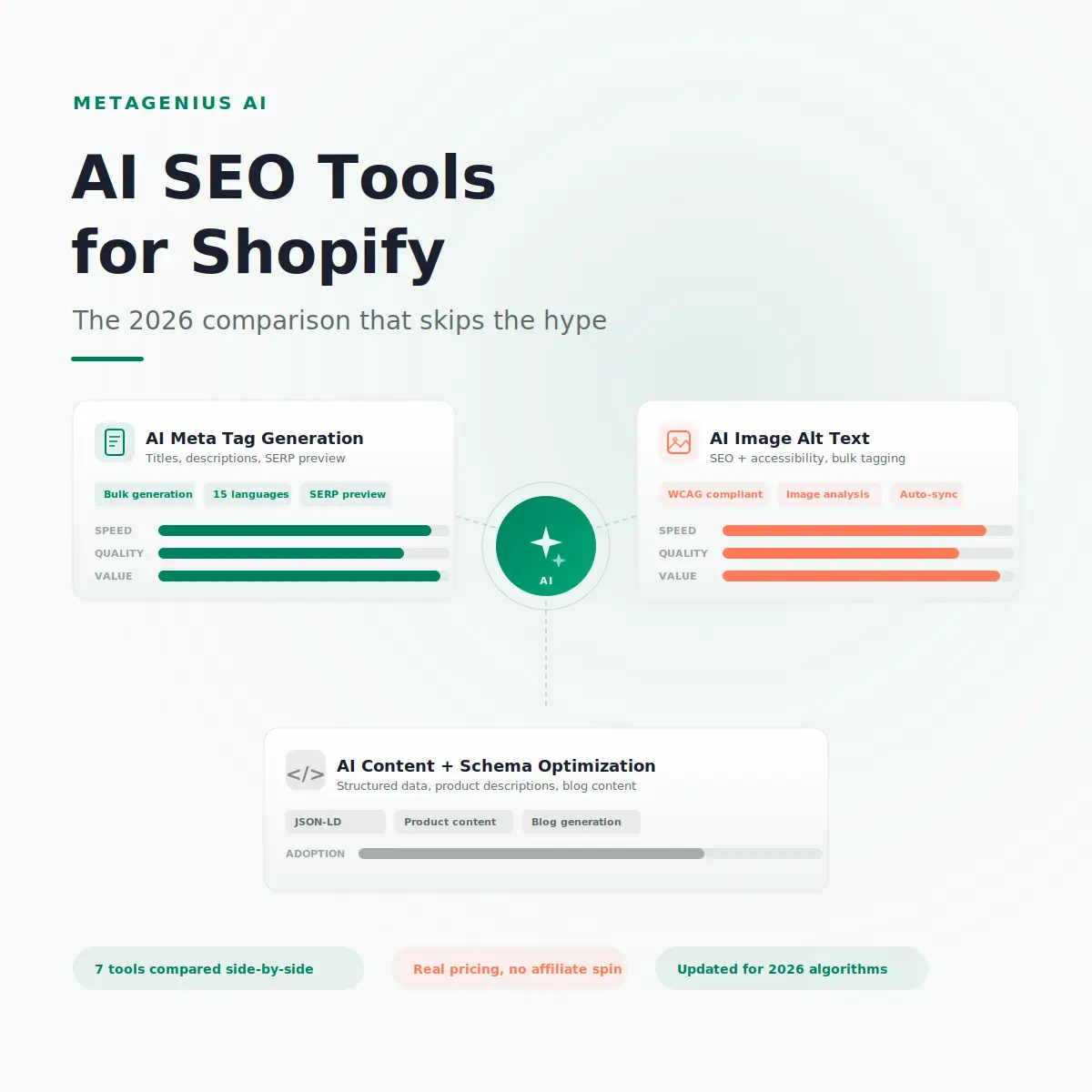
Not every "AI SEO tool" does the same thing. The Shopify ecosystem in 2026 breaks into three categories, and a store running $50K–$500K/month probably needs tools from at least two of them:
Category 1: AI meta tag generation
These tools write meta titles and meta descriptions for your products, collections, blog posts, and pages. The best ones analyze your product data (title, description, variants, images) to generate keyword-aware, intent-matched metadata. This is the highest-ROI category for most stores — meta tags directly influence click-through rates from search results, and most Shopify stores leave them blank or templated.
For a deep dive on whether AI meta tag generators actually work, see our AI meta tag generator analysis.
Category 2: AI image alt text
These tools generate alt text for product images — the text that tells search engines and screen readers what the image shows. With Google Images driving 22.6% of all search queries and the European Accessibility Act now enforceable (fines up to €500,000), this category has gone from "nice to have" to critical. The best tools analyze the actual image content, not just the product title.
See our Shopify alt text generator guide for a complete breakdown of this category.
Category 3: AI content and schema optimization
These tools generate or rewrite product descriptions, blog content, and structured data (JSON-LD schema). This is the riskiest category — Google's scaled content abuse policies target exactly this kind of bulk content generation. The tools that work here are the ones that assist writing (suggesting improvements, catching errors, generating first drafts for human editing), not the ones that fully automate publishing.
AI SEO Tools for Shopify: Side-by-Side Comparison
Here's how the major tools stack up across all three categories. We're comparing based on what they actually do inside Shopify — not what their marketing pages claim.
| Feature | MetaGenius AI | Booster SEO | Smart SEO | SearchPie |
|---|---|---|---|---|
| AI meta titles | ✓ Bulk + preview | ✓ Template-based | ✓ Template-based | ✓ Basic |
| AI meta descriptions | ✓ Bulk + SERP preview | ✓ Template-based | ✓ Template-based | ✓ Basic |
| AI image alt text | ✓ Bulk, image-aware | ✕ | ✕ Template only | ✕ |
| Live Google SERP preview | ✓ | ✕ | ✕ | ✓ |
| Multi-language generation | 15 languages native | English-focused | Hreflang only | English-focused |
| Auto-sync new products | ✓ Webhooks | ✓ | ✓ | ✕ |
| Custom AI instructions | ✓ + 9 tone presets | ✕ | ✕ | ✕ |
| Starting price | Free (10 credits) | $39/month | Free (limited) | $39/month |
A few things stand out. Most competitor tools use template-based generation — they swap in the product name and apply a fixed pattern, which produces the near-duplicate problem we covered in our duplicate meta descriptions guide. MetaGenius AI generates each description from the product's actual content, producing genuinely unique output per page.
On alt text specifically: most Shopify SEO apps either skip it entirely or use a crude template ("[Product Title] image"). MetaGenius AI is the only tool in this comparison that analyzes product data to write descriptive, WCAG-compliant alt text in bulk. For a store doing $100K/month, missing image search traffic (22.6% of searches) is a $10K+/month opportunity cost.
AI Meta Tag Tools: What to Look For
All four tools in the comparison generate meta tags. The difference is how they generate them — and that difference determines whether Google uses your descriptions or rewrites them.
Template-based vs. content-based generation
Template-based tools apply a formula: "[Product Name] - Buy at [Store Name]. [Benefit]. Shop now." The product name changes; everything else stays the same across hundreds of pages. This is fast — but Google's March 2025 Core Update specifically flagged this pattern as scaled content. Content-based generation (what MetaGenius AI uses) analyzes each product's title, description, variant data, and images to write a genuinely unique description. The output is different for every product because the input is different.
The SERP preview matters more than you think
A live Google SERP preview shows you the exact pixel-width rendering of your meta title and description before it goes live. Without it, you're guessing whether Google will truncate your text. At the 155-character truncation point, even a few characters over can trigger a full rewrite by Google. A preview eliminates that guesswork.
Bulk generation speed
If you're running 500+ products, the generation speed matters. MetaGenius AI processes at roughly 2 seconds per product — a 500-product catalog completes in about 15 minutes of background processing. Some competitors require manual product-by-product editing, which defeats the purpose of using AI.
AI Alt Text Tools: The Underrated Category
Alt text is the most underinvested part of Shopify SEO. The WebAIM Million 2026 study found that missing alt text is the #2 most common WCAG failure across the web — and most Shopify merchants don't even know the field exists.
Here's the counterintuitive part that Cyrus Shepard's on-page research backs up: alt text's biggest SEO value isn't page-level ranking (it's a light signal). It's image search traffic. Google Images drives 22.6% of all searches. For visual product categories — fashion, jewelry, home décor, beauty — image search traffic can equal or exceed regular organic traffic. Product images without alt text simply don't appear in those results.
MetaGenius AI is currently the only Shopify-native tool that generates descriptive, product-aware alt text in bulk. Other apps either skip alt text entirely or use a "[Product Name] image" template that provides zero descriptive value. For a complete walkthrough of our alt text approach, see the Shopify alt text generator guide.
WCAG 2.2 Success Criterion 1.1.1 requires a text alternative for every non-decorative image. The European Accessibility Act, enforceable since June 2025, applies to any e-commerce site selling to EU customers — including US and UK stores with international shipping. Fines run up to €500,000. This isn't optional compliance theater; it's enforceable law with real financial consequences.
AI Content and Schema Tools: Use with Caution
This is the category where "AI SEO" earned its bad reputation. Bulk-published AI blog posts, auto-generated product descriptions with no human review, and AI-written "guides" that just reformulated the top-ranking competitor's content — Google's September 2025 Spam Update crushed all of it.
Where AI content tools work
- Product description first drafts: AI generates a starting point; your team edits for brand voice, accuracy, and specifics the AI missed.
- Schema markup generation: Structured data (JSON-LD for Product, FAQPage, HowTo) is highly formulaic — perfect for AI. The output is code, not prose, so there's no "quality" concern.
- SEO audit suggestions: Tools like Ahrefs and Moz use AI to flag issues (missing meta tags, broken links, thin content) — a legitimate use that doesn't generate customer-facing content.
Where AI content tools fail
- Blog posts published without editing: Google's Helpful Content guidance is explicit: content "created primarily to attract visits from search engines" gets demoted. AI blog posts that don't add original insight or expertise are exactly this.
- Fully automated product descriptions: If AI writes 500 product descriptions and nobody reviews them, the output will contain errors, brand-voice inconsistencies, and occasionally hallucinated features. One wrong claim about a product can create customer service and legal issues that far outweigh the SEO benefit.
The safe rule: AI generates the first draft; a human publishes the final version. That workflow is both Google-compliant and practically sound.
How to Evaluate AI SEO Tools for Your Store
After auditing 60+ Shopify stores in Q1 2026, three factors consistently predicted whether an AI SEO tool delivered results or wasted the subscription fee:
1. Does it generate unique output per page?
Run the tool on 10 products and compare the output. If more than 2 descriptions share the same structure with only the product name swapped, the tool is template-based and will trigger Google's scaled content signals. Each output should read like it was written for that specific product.
2. Does it integrate natively with Shopify?
Tools built with Shopify's Polaris design system and embedded directly in your admin save time and reduce errors. External dashboards that require copy-pasting between tabs are friction points that kill adoption — your team will stop using the tool within a month. For a broader view of the Shopify SEO app landscape, see our honest buyer's guide.
3. Does it show you the output before publishing?
A live preview (SERP preview for meta tags, thumbnail + alt text preview for images) is the single most important quality control feature. Without it, you're publishing AI output blind — and that's how errors get shipped to production.
4. What's the cost-per-product math?
Calculate the actual unit economics. MetaGenius AI's Pro plan at $14.99/month gives you 500 credits. That's $0.03 per product for meta tags + alt text. A freelance copywriter charges $25–$150 per product page. A VA at $15/hour takes 5–10 minutes per product, or $1.25–$2.50 each. The AI approach is 40–80x cheaper — and faster by orders of magnitude.
What AI SEO Tools Can't Do (Yet)
Honest limits — including our own:
- Strategy: AI tools optimize existing pages. They don't decide which keywords to target, which products to prioritize, or how to position your brand against competitors. That's still human work.
- Link building: No Shopify AI tool generates backlinks. Links come from content marketing, PR, and partnerships — all human-driven.
- Technical SEO infrastructure: Canonical tags, robots.txt configuration, Core Web Vitals optimization, hreflang implementation — these require developer understanding of your site architecture. AI tools can flag issues; they can't fix server configuration.
- Brand voice perfection: AI-generated copy is 85–90% of the way there. The last 10% — the phrasing that sounds exactly like your brand, the joke that lands, the specific reference your audience gets — still needs a human pass. MetaGenius AI's custom instructions and tone presets close the gap, but they don't eliminate it entirely.
The stores getting the best results from AI SEO tools are the ones that understand these limits and staff accordingly. AI handles the volume work. Humans handle the strategy and the final quality check. That combination outperforms either approach alone.
Frequently Asked Questions
AI SEO that Google rewards, not penalizes.
MetaGenius AI generates unique meta tags and image alt text for your entire Shopify catalog — in bulk, in 15 languages, with a live SERP preview before anything goes live. Free plan, 30-second install.
Install Free on the Shopify App Store →