The advice is everywhere: "Write descriptive alt text for every product image." Nobody disagrees. The problem isn't knowing what to do — it's doing it 2,000 times across a real product catalog without losing your mind or your weekend.
A 500-product Shopify store with 4 images each has 2,000 images. At 2.5 minutes per description (the realistic average when you include navigating to the image, thinking, typing, and reviewing), that's 83+ hours of manual work — more than two full work weeks of nothing but writing alt text. Add new products weekly and you're stuck on a treadmill that never ends.
AI alt text generators solve the scale problem. But they introduce a quality question: is AI-generated alt text actually good enough for SEO and accessibility? This post answers that honestly — where AI wins, where manual still has an edge, and the workflow that gets you the best of both.
The Scale Problem Manual Can't Solve
Manual alt text works beautifully for 20 images. It starts cracking at 200. It breaks completely at 2,000. The math is simple and unforgiving:
- 500 products × 4 images = 2,000 descriptions
- At 2.5 min each = 83 hours — that's 10+ working days of pure writing
- New products added weekly compound the debt — 20 new products/week × 4 images = 80 fresh descriptions every week, forever
- Seasonal refresh — meta tags and alt text should be reviewed every 3–6 months, effectively resetting the clock
The result is what the 2026 WebAIM Million report confirms: more than one in four images on popular websites has alt text that's either missing or inadequate. It's not that merchants don't care. They can't keep up.
Hiring out doesn't fix the economics either. A freelance copywriter charges $25–$150 per product page. For 500 products, that's $12,500–$75,000 for a single pass. And you'll need to redo it when you add new products or seasonal collections.
How AI Alt Text Actually Works
Not all AI alt text is the same. There are two fundamentally different approaches, and the difference matters for quality:
Approach 1: Vision-only (image recognition)
Tools using pure computer vision (Google Cloud Vision, Amazon Rekognition, generic image captioning models) analyze the pixels of your image and describe what they "see." A product photo might return: "a blue garment on a white surface." That's technically accurate and practically useless — it doesn't include the product name, material, variant, or any searchable detail.
John Mueller addressed this directly on Reddit. He cautioned that AI-generated alt text based purely on image analysis produces descriptions like "photo of a beach" — technically correct but missing the context of why that image exists on your page. For product images, that means you get "blue shirt" instead of "Men's navy organic cotton crew-neck t-shirt, front view."
Approach 2: Product data + context (what MetaGenius AI does)
MetaGenius AI takes a different approach. Instead of analyzing pixels, it reads your Shopify product data — title, description, variant attributes (color, size, material), collections, and tags — then generates alt text that's descriptive, keyword-natural, and contextually accurate. The result: "Men's navy organic cotton crew-neck t-shirt, front view" instead of "blue garment on white background."
This product-data approach produces stronger alt text for SEO because it uses the same language your customers search for, and stronger alt text for accessibility because it describes the product in terms a shopper actually needs to hear.
Head-to-Head: AI Alt Text vs Manual
| Dimension | AI alt text (product-data) | Manual writing |
|---|---|---|
| Speed | ~2 seconds per image | 2–3 minutes per image |
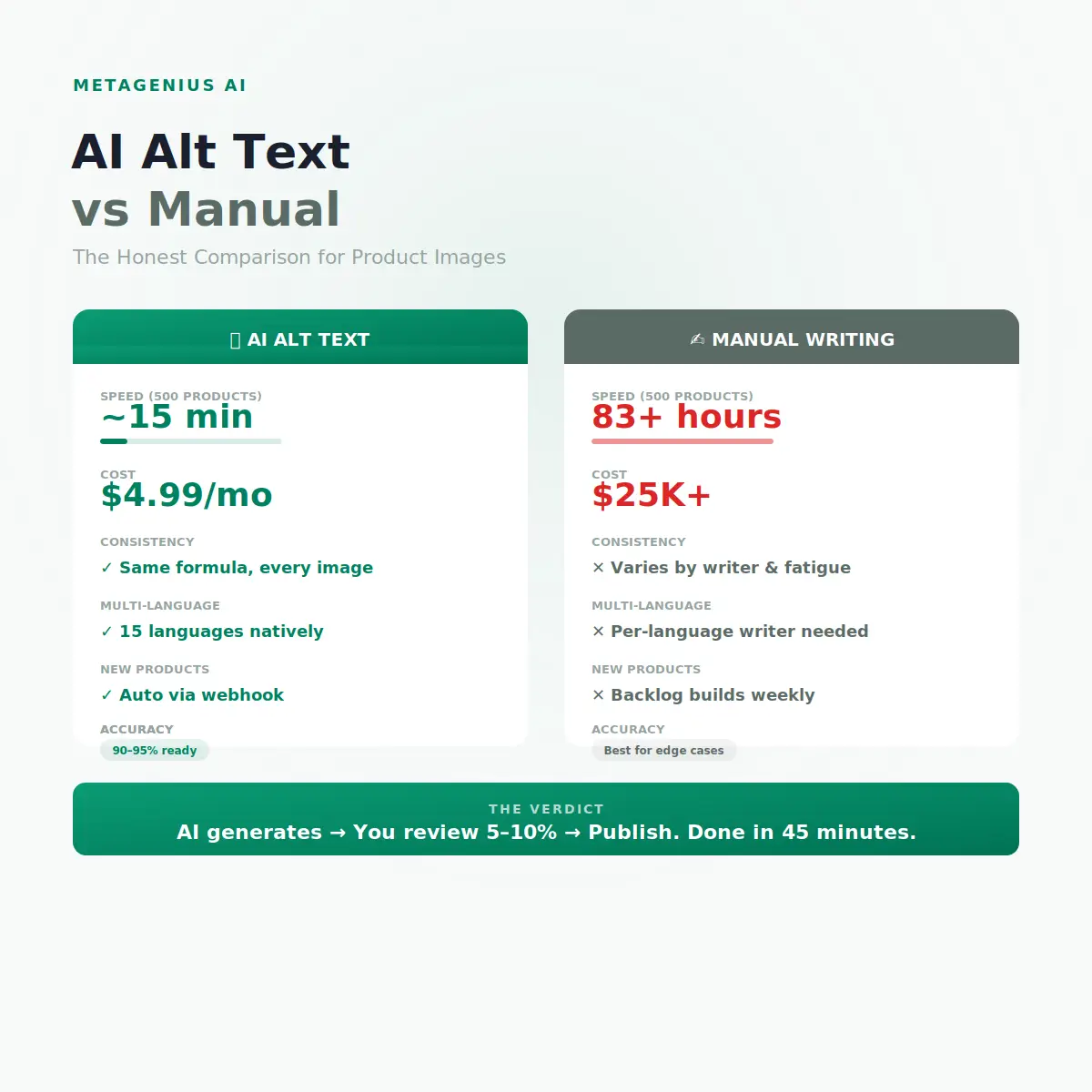
| 500-product catalog | ~15 minutes + review | 83+ hours |
| Consistency | ✓ Same formula every time | Varies by person, day, fatigue |
| Keyword accuracy | ✓ Pulled from product data | ✓ Full control (if writer is SEO-aware) |
| Context awareness | Good — reads product data | Best — human judgment on brand nuance |
| Lifestyle/editorial shots | Weaker — can't see scene context | ✓ Human describes what they see |
| Multi-language | ✓ 15 languages natively | Per-language writer needed |
| New product coverage | ✓ Auto-generated via webhook | ✕ Manual backlog builds |
| Cost (500 products) | $4.99–$14.99/month | $12,500–$75,000 one-time (freelance) |
| Error rate | 5–10% need tweaks | ~3–5% errors (typos, missed details) |
Where AI Alt Text Wins Decisively
1. Speed and throughput
This isn't close. 2 seconds per image vs 2–3 minutes. For a catalog of any meaningful size, AI is the only option that ships before next quarter.
2. Consistency
Manual alt text varies wildly depending on who writes it, what time of day it is, and how many images they've already described. Writer fatigue is real — image #500 gets a fraction of the attention image #5 got. AI applies the same formula with the same quality ceiling across the entire catalog.
3. Multi-language support
If you sell through Shopify Markets in multiple languages, every image needs alt text in every language. Manual means hiring per-language writers. MetaGenius AI generates natively in 15 languages — not translated, written from scratch in each language with native-sounding phrasing.
4. New product coverage
MetaGenius AI's webhook integration means every new product you add to Shopify gets alt text automatically on creation — before it goes live. Manual workflows always lag behind new inventory, creating a growing alt text backlog that compounds over time.
5. Cost at scale
$14.99/month for a Pro plan covers 500 credits. A freelance copywriter charging $50/page for 500 products = $25,000 for a single pass. The MetaGenius annual cost ($180) is less than what a copywriter charges for four product pages.
Where Manual Alt Text Still Wins
We're being honest here — AI isn't better at everything.
1. Lifestyle and editorial shots
A product-data AI tool describes the product, not the scene. A lifestyle shot of "Model wearing olive linen dress while walking through a Tuscan village at sunset" requires visual understanding that product-data AI doesn't have. Vision-language models are getting better at this, but in 2026 they still miss scene-level nuance.
2. Brand-specific vocabulary
If your brand calls its colour "Sahara Sand" instead of "beige," a human writer captures that. AI defaults to the variant attribute in Shopify, which may or may not match your marketing language. MetaGenius AI's custom instructions feature helps here — you can tell the AI to use your brand vocabulary — but it still requires setup.
3. Complex images
Infographics, comparison charts, images with embedded text — these need human judgment to decide what to include in the alt text and what to describe in adjacent HTML. AI can't make editorial decisions about information hierarchy.
The Right Workflow: AI + Human Review
The answer isn't AI or manual — it's AI-generated with human review. Here's the workflow that gets you the quality of manual writing at the speed and cost of automation:
- Step 1: Bulk generate with AI. Run MetaGenius AI across your product catalog. 500 products takes about 15 minutes.
- Step 2: Review the output. Scan through the generated alt text. About 90–95% will be ready to publish. Flag the 5–10% that need tweaks — usually lifestyle shots, complex variants, or brand-specific terminology.
- Step 3: Tweak the flagged items. Manually edit the flagged descriptions. This takes 15–30 minutes for a 500-product catalog — instead of 83 hours for the full manual approach.
- Step 4: Publish. MetaGenius AI lets you review before writing to Shopify. Click publish when you're satisfied.
- Step 5: Enable auto-generation. Turn on webhook auto-sync so new products get alt text on creation. Review weekly.
Total time: ~45 minutes for 500 products. Compare that to 83 hours manual. Same quality outcome, 99% less time.
For the step-by-step on each bulk method, see our guide to bulk adding alt text in Shopify.
What Google Says About AI Alt Text
Google's position on AI-generated content applies to alt text too. The Helpful Content guidance is clear: AI assistance is fine, scaled spam isn't. The distinction is whether a human reviews and takes responsibility for the output.
Mueller made this more specific for alt text in a Reddit discussion. His concern wasn't with AI-generated alt text per se — it was with pure image-recognition AI that produces generic captions like "photo of a beach" without understanding page context. Alt text generators that read product data and produce descriptions like "Men's navy merino crew-neck sweater, front view" are fundamentally different — they're producing useful, contextual descriptions, not generic captions.
The practical test: would the alt text be useful to a screen reader user evaluating whether to buy this product? If yes, Google considers it helpful content regardless of whether a human or AI wrote it.
Since the March 2025 Core Update, Google has further weighted first-party data signals. Product data alt text — pulled from your own Shopify inventory — is inherently first-party. That aligns with where Google is heading.
Frequently Asked Questions
83 hours or 45 minutes. Same result. Your call.
MetaGenius AI generates SEO- and accessibility-ready alt text for every product image in your Shopify catalog — from product data, not generic image recognition. Install the app. Select your products. Click "Generate." Review, tweak the 5%, publish.
Install Free on the Shopify App Store →