You launched the store, wrote the product descriptions, set up the collections, maybe installed an SEO app. And now you're checking Google Search Console every morning, watching a flat line, wondering: is this broken, or am I just impatient?
Probably the second one. How long Shopify SEO takes is the question nobody selling SEO wants to answer honestly, because the honest answer — months, not weeks — doesn't make for a good sales pitch. Here's the version with actual numbers, the factors that move the needle, and the self-inflicted mistakes that quietly cost merchants an extra quarter or two.
By the end you'll know what's normal for a store your age and size, how to tell SEO is working before the traffic graph confirms it, and where you're most likely losing time without realizing it.
The Honest Answer: 3 to 12 Months
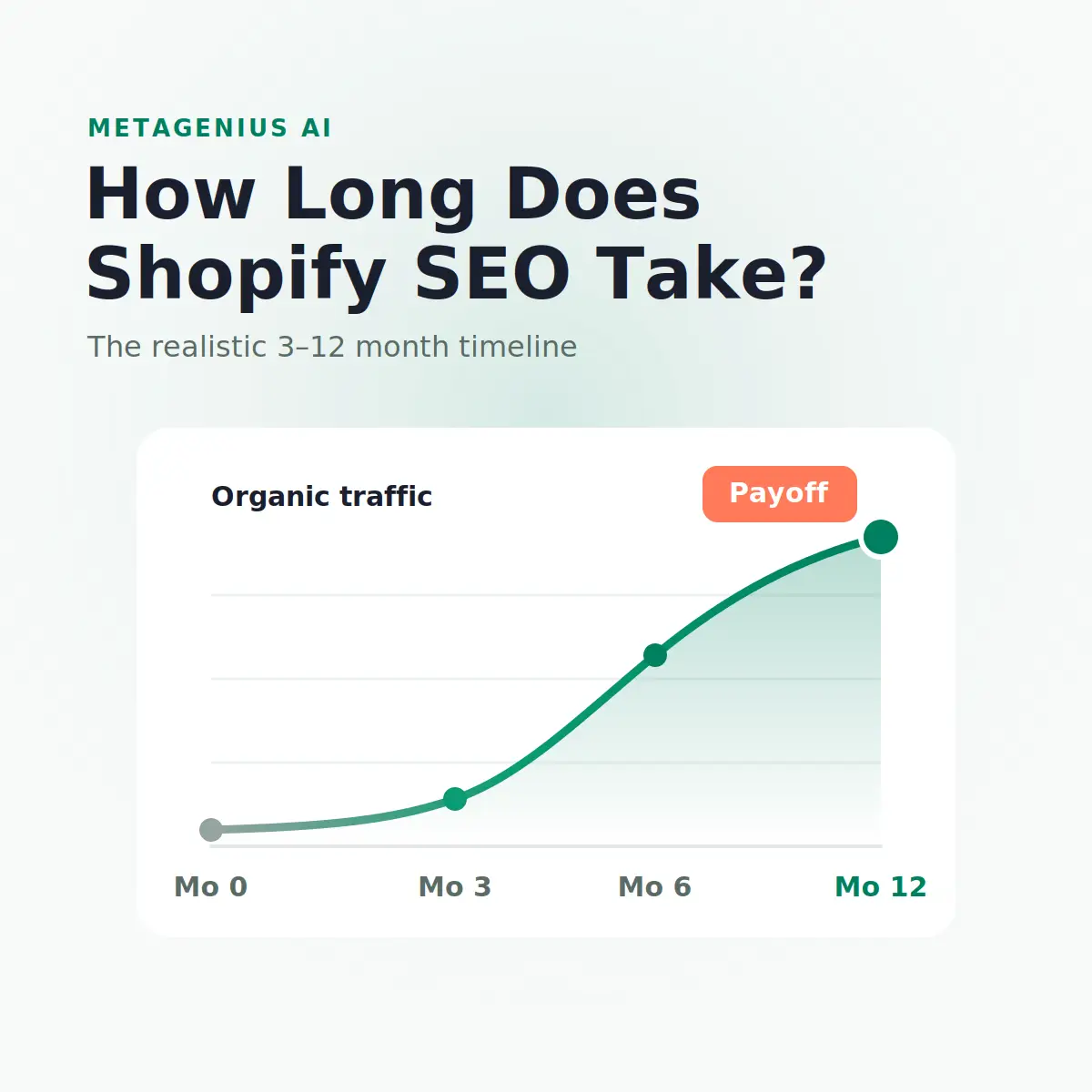
For a typical Shopify store in a competitive niche, expect the first real ranking movement around month 3 to 4, and traffic that actually changes your revenue around month 6 to 12. That's not pessimism — it's the consensus among people who do this for a living.
Google's John Mueller has said repeatedly that SEO changes often take a couple of months — sometimes longer — to be fully reflected, and that ranking is rarely instant. Ahrefs' study of two billion pages found the median page ranking in Google's top 10 is over two years old, and only a sliver of pages under a year old rank for anything competitive. The pattern is consistent: SEO compounds, it doesn't switch on.
Here's the part most merchants miss. The "3 to 12 months" applies to earning rankings through authority — fresh content, links, trust. But much of what holds Shopify stores back isn't authority at all; it's technical and on-page issues Google can fix in its index within days of recrawling. Blank meta tags, missing alt text, duplicate collection pages — fixing those isn't a 12-month play, it's a two-week play. We'll separate the two clearly, because conflating them is exactly why people give up at month two.
The Realistic Timeline, Month by Month
No two stores are identical, but the shape of the curve is remarkably stable. Here's what a healthy Shopify SEO ramp tends to look like.
| Phase | What's happening | What you'll see |
|---|---|---|
| Weeks 0–4 | Indexing & discovery. Google crawls, indexes pages, processes your sitemap. Technical fixes (meta, alt text, canonicals) get picked up. | Pages appearing in site: searches. Impressions trickle in. Almost no clicks yet. |
| Months 1–3 | Foundation. Google forms an early read on relevance and quality. Long-tail product terms start surfacing. | Impressions climbing. First clicks on very specific, low-competition queries. Rankings bouncing around positions 20–50. |
| Months 3–6 | First real traction. Authority builds; the better pages start consolidating toward page one for mid-tail terms. | Noticeable click growth. Some keywords break into the top 10. Revenue from organic becomes measurable. |
| Months 6–12 | Compounding. Established pages rank for more terms than you targeted. Internal links and trust signals reinforce each other. | The "hockey stick" — traffic accelerates faster than your effort does. This is the payoff phase. |
| 12 months+ | Maturity & defense. The work shifts from earning rankings to keeping and expanding them. | Stable, growing organic channel. New content ranks faster because the domain is trusted. |
Notice the flat front end. Months one and two feel like nothing is happening — and that's precisely when most merchants quit or start randomly changing things, which resets progress. The store owners who win are usually just the ones who didn't panic in the quiet phase.
What Actually Affects Your Timeline
Two identical-looking stores can be six months apart on results. These are the variables that decide which one you are.
Domain age and the "sandbox" effect
Google doesn't officially confirm a "sandbox," but the observable behavior is real: brand-new domains rarely rank competitively in their first few months, no matter how good the content. A store on a domain that's been live and indexed for two years has a structural head start over one registered last week. There's no shortcut here — but it's the single biggest reason a new store's timeline runs long.
Competition in your niche
Ranking for "minimalist leather card holder" is a months-shorter project than ranking for "running shoes." If your competitors are established brands with thousands of backlinks, your realistic timeline shifts toward the 9–12 month end. A merchant doing $30K/month in a tight sub-niche often sees results faster than one doing $200K/month in a saturated category.
Technical health vs. content authority
This is the distinction that changes how you should think about the whole timeline:
- Technical & on-page (fast — days to weeks): indexability, meta titles and descriptions, image alt text, canonical tags, site speed, structured data. Google recrawls and updates these quickly. Fixing them is the closest thing to a fast win in SEO.
- Authority & content (slow — months): earning links, building topical depth, accumulating the trust signals Google weighs under its E-E-A-T framework. This is the part that genuinely takes 6–12 months.
If your store is new, you're paying the authority tax no matter what. But if your store is a year old and still not ranking, the problem usually isn't time — it's an unfixed technical issue. Our guide to why Shopify SEO isn't working walks through the ten most common ones. (And consistency matters: a store that adds useful content steadily compounds in a way that month-one sprints followed by silence never do.)
How to Speed It Up (Without Tricks)
You can't skip the authority phase. But most stores leave the fast wins on the table for months — and the math is blunt: on a 500-product store doing $50K/month, recovering even a 15% organic CTR uplift from better titles and descriptions is roughly $7,500/month in influenced revenue, and it lands in a recrawl, not in twelve months.
Fix the fast wins first
- Fill every meta title and description. Shopify's defaults are usually just the product name. Custom, keyword-aware tags are recrawled within days. See how to write meta descriptions that convert.
- Add alt text to every product image. Most stores ship with images that have no alt text at all — that's lost image-search traffic and an accessibility gap, both fixable now, not in Q4. Image search is a far bigger channel than most merchants realize.
- Kill duplicate and thin pages. Especially on imported or templated catalogs, duplication splits your ranking signals. Consolidating is one of the faster needle-movers.
- Confirm you're actually indexable. A surprising number of "SEO isn't working" cases are a noindex tag or a blocked path. Check first; it costs you nothing.
Doing this by hand across hundreds of products is the part that eats weeks you don't have. A freelance copywriter charges $25–$150 per page for meta and product copy; for a 300-product catalog that's $7,500+ and a two-week turnaround per batch. This is exactly the job MetaGenius AI was built for — bulk-generating SEO-ready image alt text for every product image, plus AI meta titles and descriptions across products, collections, blogs and pages, with a live Google-snippet preview before you publish. The whole catalog, in minutes, in 15+ languages.
Stop leaving the fast wins on the table.
MetaGenius AI writes SEO alt text and meta tags for your entire Shopify catalog in bulk — in seconds, not weeks. Free plan, no credit card, and you preview every result in a live Google snippet before it goes live.
Install MetaGenius AI Free →Then let authority compound
With the foundation clean, the slow work — useful content, earned links, internal linking — does what it does best: builds on itself. As Aleyda Solis often points out, the highest-impact SEO work is usually removing what's holding a site back before adding anything new. Clear the blockers first, then plant.
What Quietly Resets the Clock
The cruelest version of "SEO takes a long time" is when you've actually been waiting twelve months — but kept restarting the timer without knowing it. The usual culprits:
- A noindex left on after launch. Themes and staging setups sometimes ship with it; every week it stays is a week of zero progress.
- Changing URLs without redirects. Reorganizing collections and letting old URLs 404 throws away the equity those pages had earned.
- Duplicate content at scale. Common on dropshipping catalogs using supplier descriptions verbatim. Google picks one URL and ignores the rest — it feels like a penalty, but it's a filter effect, and the strategy fix differs from a penalty fix.
- Chasing every algorithm rumor. Rewriting your whole site after each rumored update keeps Google permanently re-evaluating you. Lily Ray's recovery analyses after recent core updates consistently show stability and a clear quality trajectory matter more than reactive thrashing.
- Thin product pages. A title and a price isn't enough to rank in 2026 — pages that look auto-generated have been demoted since the March 2024 Helpful Content update.
If any of these sound familiar, your timeline isn't long — it's been reset. Fix the cause and the clock starts counting for real.
How to Know It's Working Before Traffic Moves
The traffic graph is a lagging indicator — by the time clicks climb, the real progress happened weeks earlier. Watch these leading signals so you're not flying blind through the quiet months:
- Impressions in Search Console. Rising impressions mean Google is showing you for more queries — the earliest sign of life, often visible by week 3–4.
- Average position creeping up. Moving from position 45 to 22 produces almost no clicks but is real progress toward page one.
- Indexed page count. More of your catalog indexed = more surface area to rank. Track it monthly.
- Long-tail clicks first. Your earliest clicks will be on oddly specific queries — that's the normal, healthy base of the pyramid.
If impressions and average position are trending up, SEO is working — the revenue is just still in the post. If they're dead flat after 8–10 weeks on a properly indexed store, that's your signal to audit rather than wait. For the deeper diagnostic, see why your store isn't showing up on Google.
Frequently Asked Questions
*Ahrefs' two-billion-page study found roughly 95% of pages receive no organic search traffic from Google — a reminder that ranking requires deliberate optimization, not just publishing.
SEO takes months. The fast wins don't.
While authority builds, fill every meta tag and image alt text across your catalog — the changes Google recrawls in days. MetaGenius AI does it in bulk, in seconds, in 15+ languages, with a live Google preview before you publish.
Install Free on the Shopify App Store →